Backcountry Journal

Welcome to BHA’s new website! This digital campfire is still being built—thanks for bearing with us as we get it burning bright.

Backcountry Journal

What's New

Stay tuned for our next issue!


Past Editions & More

Return of the Buffalo

Posted by: Christine Peterson | Wednesday, May 17, 2023

Click HERE to read the Fall 2024 issue of Backcountry Journal!

More than 30 million bison once roamed North America. Only about 50,000 now live in wild herds, leading ecologists to say the buffalo is “functionally extinct.” Will the nation’s mammal and a symbol of the West endure?


This story originally appeared in the Summer 2021 issue of Backcountry Journal.

By Christine Peterson


Ervin Carlson was in his 20s when he saw a bison.

The creatures were being brought back to the Blackfeet Indian Reservation in northern Montana, a place they’d lived for millions of years until they were exterminated nationwide by the early 1900s.

Carlson grew up without buffalo, just like his parents, and just like nearly every other Native American in the United States.

It’s why he couldn’t quite grasp the animal’s power and spirit until seeing it that day, decades ago. Even then, he’s not sure he fully understood.

But he would soon enough.

Carlson has been the president of the Intertribal Buffalo Council for well over two decades. In that position, he’s overseen bison reintroduction onto tribal lands across the country and even helped figure out how to fly three bull bison to Alaska.

“We’re restoring the buffalo for our cultural connection,” Carlson said, “but also because they used to be our economy and past history, and they can take care of us, too.”

He’s one of many Montanans, Westerners, conservationists and hunters working to restore the buffalo to the West. But it’s not an easy road. When pushed too hard, they can be big, unruly and ill-tempered. They don’t always like fences and have little regard for vehicles. But they’re also one of the best original stewards of the land.

And believe it or not, figuring out the logistics of transporting thousands of pounds of living bison to Alaska via container ship, barge and plane is actually one of the least challenging pieces in the effort to bring bison back. The politics of bison restoration is the tough part. They’re a species that once numbered more than 30 million and were systematically slaughtered down to less than 1,000. About half a million bison now roam North America, with more than 50,000 living as wild animals. Even with those gains, the most ambitious goals call for more of these scattered herds, many parts making a whole. Ask those most involved in the bison restoration process if one of the most iconic species of the American West, and the national symbol of the United States, could truly roam free again, and they’ll tell you maybe, sort of, it depends.

But those same bison advocates also say any gains are important, and maybe scattered populations are enough for now.


Unimaginable Slaughter

Most of us likely know the story of the American bison, at least the basic points: Bison roamed across much of the U.S. from Canada to Mexico and New York to Oregon. Their numbers were particularly strong in the Great Plains where they moved in waves across the grasslands, spreading native seeds with their hooves and fur and fertilizing vegetation with their manure. They rarely stayed anywhere long.

Buffalo were critical to the nation’s first people, where humans, buffalo and countless other wildlife lived alongside one another.

But as settlers moved into the West, the bison’s fortune changed quickly. 
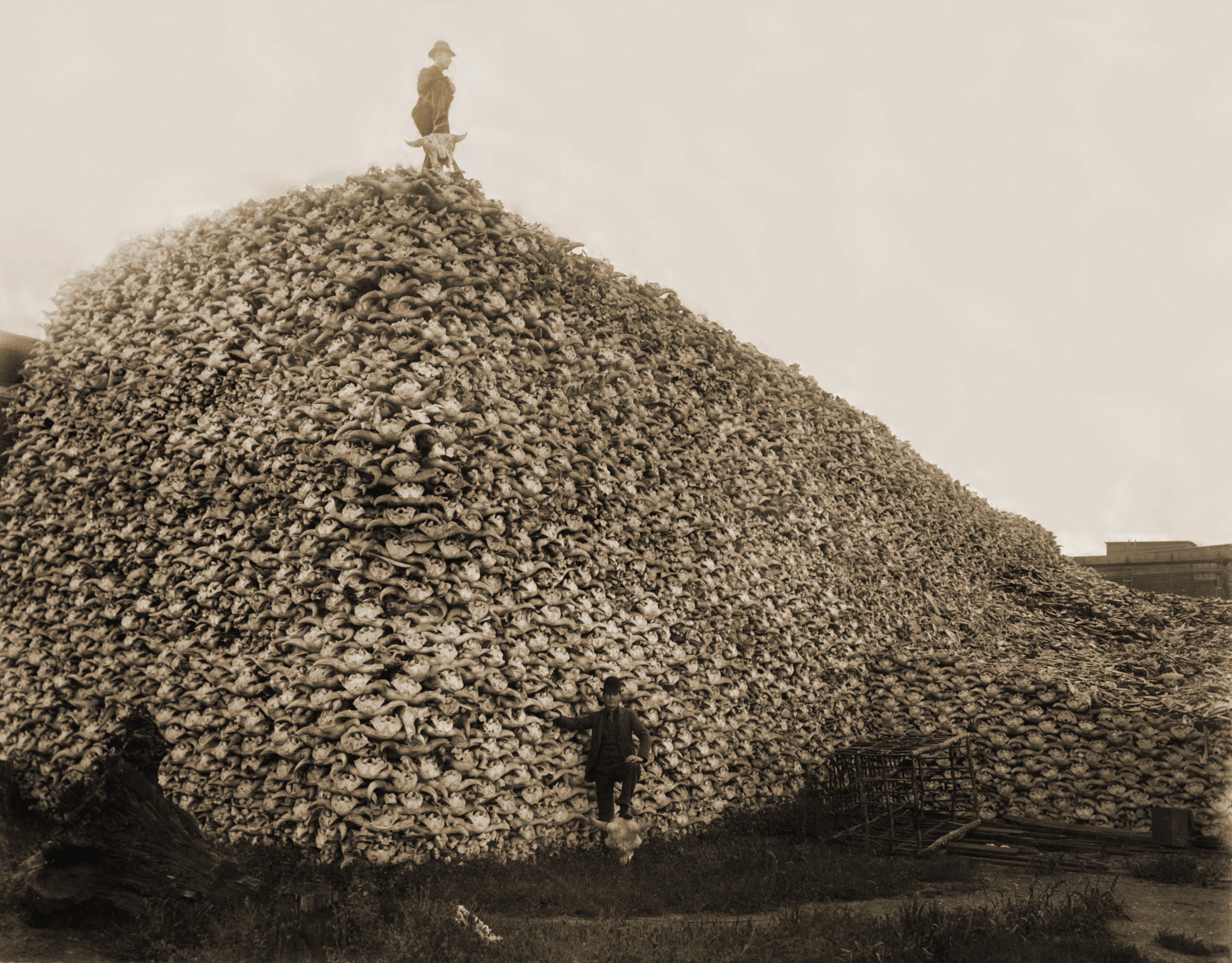
Bison were viewed three ways: a commodity to be killed, butchered and sold; a hinderance to an expanding rail system and competition with domestic livestock; and a critical resource for tribes fighting to maintain their homelands.

Bison were viewed three ways: a commodity to be killed, butchered and sold; a hinderance to an expanding rail system and competition with domestic livestock; and a critical resource for tribes fighting to maintain their homelands.

The answer to all of those was mass slaughter, and the numbers are staggering.

In 1870, about 2 million bison were killed on the southern plains, according to the U.S. Fish and Wildlife Service. Their hides were used for leather, their bones used in refining sugar, making fertilizer and fine bone china.

“Bison bones were bought from $2.50 to $15 a ton,” the Fish and Wildlife Service said. “Based on an average price of $8 per ton, they brought $2.5 million into Kansas alone between 1868 and 1881. Assuming that about 100 skeletons were required to make one ton of bones, this represented the remains of more than 31 million bison.”

Slaughter peaked on the southern plains around 1873 with hides selling for $1.25 each and tongues for 25 cents.

“A railway engineer said it was possible to walk a 100 miles along the Santa Fe railroad right-of-way by stepping from one bison carcass to another.”
Some officials made efforts along the way to stem the bloodshed. The Idaho State Legislature passed a law to protect bison in 1864, after buffalo no longer roamed the state. Wyoming and Colorado passed laws making it illegal to waste bison meat, but they were not enforced. The U.S. House and Senate even passed a bill in 1874 to protect female bison and prevent wanton destruction, but President Ulysses Grant wouldn’t sign the legislation.
Ultimately, the bison’s fate was a foregone conclusion. Markets were hungry for hides. Governments and companies were ready for railroad connectivity. Generals William T. Sherman and Philip Sheridan “viewed the eradication of the buffalo as the ‘critical line of attack’ in the struggle with the Plains Tribes,” according to the Western Historical Quarterly out of Utah State University.

And the bison extermination worked.

By the late 1870s, bison in the southern portion of the U.S. had all but been eliminated, and by the mid-1880s, only around 1,000 wild buffalo remained.
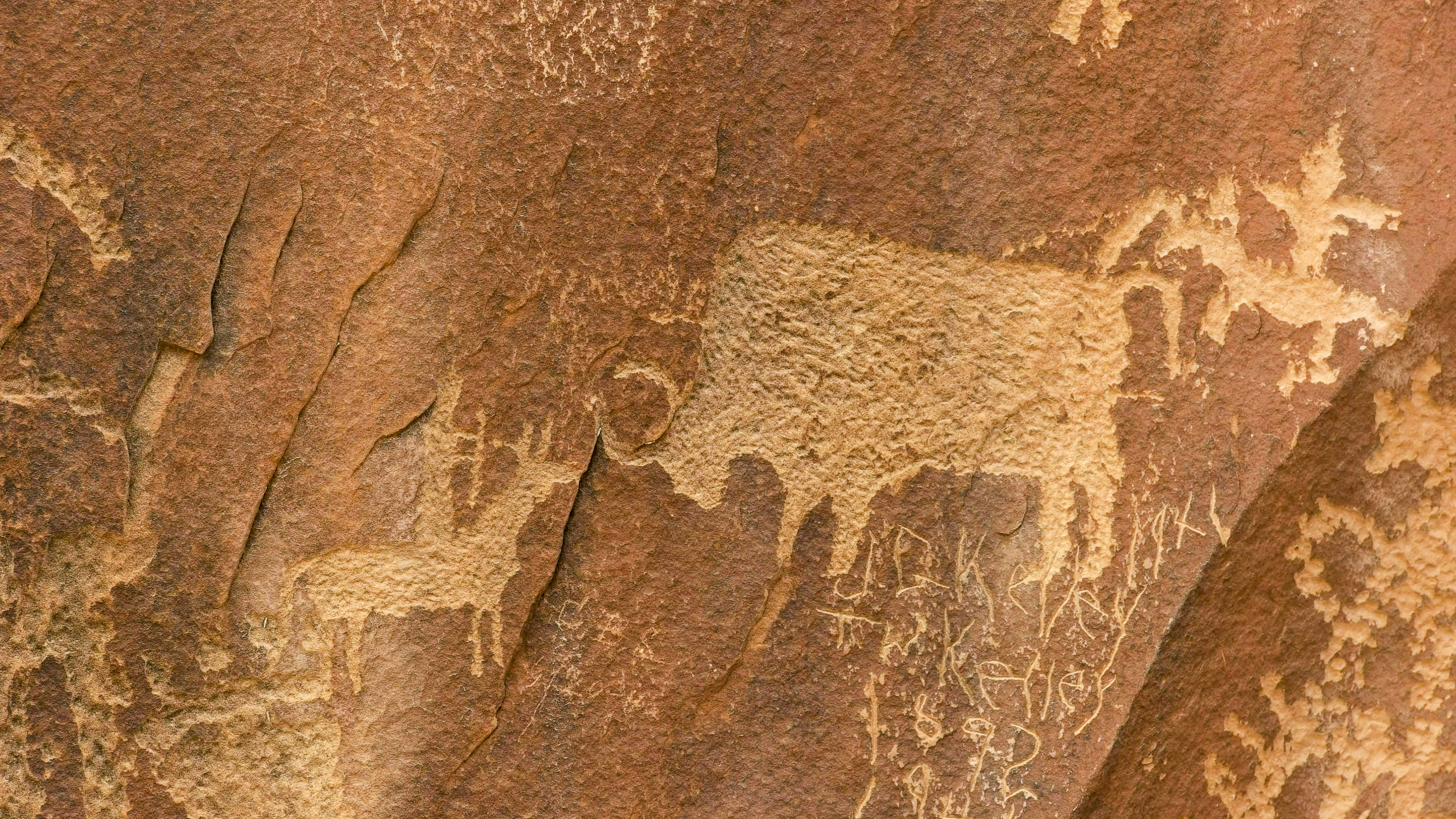

Above: Bison hunting scene depicted on Newspaper Rock, near Canyonlands National Park, Utah. Photo: istock.com/ crbellette

Brothers

It’s impossible to tell the story of the buffalo without the nation’s tribes.

Buffalo were not only food for most native people living in the middle of the continent, they were also the source of housing, clothing, tools and, perhaps even more importantly, they were brothers, spiritually connected to one another.

“The tribes and buffalo go hand in hand,” Carlson said. “We lost a lot of our culture coming in with settlement. They took our language, and we’re bringing that back. They took our way of religion and our land. A lot of things we lost in our culture and so to me, restoring buffalo is helping to bring back a part of our culture that was lost.”

The Intertribal Buffalo Council formed in the early ‘90s to “restore bison on Tribal lands for cultural and spiritual enhancement and protection,” its website reads.

Almost 75 tribes now belong to the organization, and bison have been restored to almost 1 million acres of tribal land across the country including the Assiniboine and Sioux on the Fort Peck Reservation in northeastern Montana, the Shoshone and Arapaho on the Wind River Reservation in central Wyoming, and the Sisseton Wahpeton Oyate at Lake Traverse Reservation in northeastern South Dakota. About 20,000 wild buffalo now live on tribal lands managed as cultural herds.

The hope is for bison to once again be part of the tribes’ cultural connection but also used in their economy.

“The Blackfeet are getting back to eating the healthy meat and lifestyle we used to have,” Carlson said. “Diabetes is so rampant in Indian Country, that just eating healthy foods again can help.”

But even restoring bison to tribal lands has been met with resistance from nearby cattle ranchers worried about bison potentially spreading disease, breaking down fences and competing for forage.

“I hear from the non-Indian ranchers that they don’t want to lose their land,” he said. “I know the feeling.”


Restoration Efforts

Ask any bison expert, or most anyone in the West, if bison will ever reach close to the numbers they once had, and they’ll say no.

The time where the Western landscape could support 30 million creatures that weigh up to 2,000 pounds and stand 6.5 feet tall that need space to move around is gone. But efforts are underway to restore at least some of what’s been lost.

And ironically, some of the first attempts to preserve and restore bison came from the very people who participated in their destruction.

In 1905, the Bronx Zoo’s first director, William Hornaday, and former President Theodore Roosevelt launched the American Bison Society to create wild bison reserves.

“People were saying bison were going to go extinct and the Wildlife Conservation Society needed to buy up bison from people who saved them and set up lands for them to be protected,” said Cynthia Hartway, science lead with WSC’s Rocky Mountain Program. “They bought some bison and negotiated to have bison brought to them at the Bronx Zoo to set up a breeding program. Then they found lands on the Wichita and Niobrara refuges, and that was the start of modern conservation of bison.”

Now of approximately half a million bison roaming the U.S., about 33,000 to 34,000 are managed as wild herds. Roughly 4,500 of those are in Yellowstone National Park. The U.S. National Park Service only wants about 3,000 in the herd, and any that wander north out of the park into Montana are either hunted, rounded up for slaughter or sent to quarantine to then go to tribal lands and other reintroduction efforts.

The rest are dispersed on wildlife trust lands, federal public lands like Book Cliffs in Utah, state lands like Custer State Park in South Dakota, and places like the American Prairie Reserve in Montana and Southern Plains Land Trust in southern Colorado.

Nearly every species on the Plains evolved with bison and in some ways relied on them. Bison created large landscape variations perfect for grassland birds. They distributed seeds from plants and kept encroaching trees at bay. The plants and flowers then supported pollinators. Prairie dogs and bison needed one another, and black-footed ferrets relied on prairie dogs.

“Bison are the best gardeners to put out on the grasslands and build healthy soils,” said David Carter with the National Bison Association. “North American grasslands are like the North American rainforest. The grasslands are an incredibly effective carbon sink and … are a more resilient carbon trap than forests.”

Which is why private groups like the American Prairie Reserve are buying up land and reestablishing wild herds.

The APR, as it’s often called, started in June 2001 as a response to a late ’90s report highlighting the need for conserving critical areas of the Great Plains, especially one portion of northeastern Montana.

“Our main focus is to purchase and permanently hold title to private lands that glue together a vast mosaic of existing public lands so that the region is managed thoughtfully and collaboratively with state and federal agencies for wildlife conservation and public access,” according to organizational story.
The organization’s ultimate goal is to pull together 3 million acres of public and private lands because that’s about how much biologists say it would take to create a fully functioning ecosystem in the prairie with migration corridors.

It has, according to its online reports, acquired almost 105,000 acres of private land that works together with more than 315,000 acres of public land.
For Carlson, the APR concept is a dream come true.

But local communities aren’t so sure.

“I see them coming in with big money, buying up ranches and walking over the top of the people who are already here,” said Montana ranch owner Conni French in a 2019 interview with National Public Radio. “For them to be successful in their goals, we can’t be here, and that’s not OK with us.”
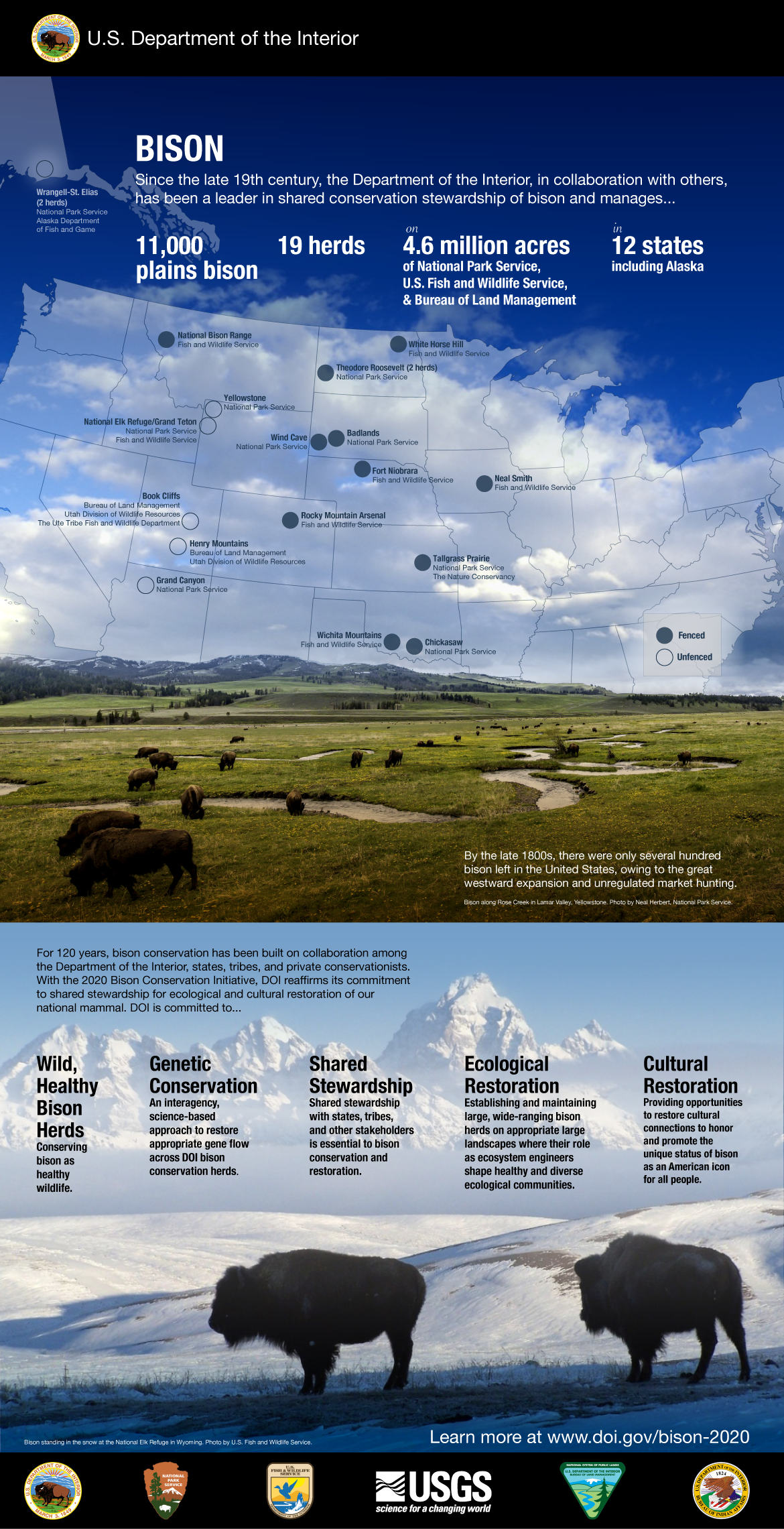

DOI-Bison-Accomplishments-FINAL-lrg-lr.png


Steaks and Burgers

Of the half a million bison in the United States, about 440,000 of them are living on private bison ranches. You’ve likely seen them off Interstate 25 in northern Colorado, near Gillette, Wyoming, or around Jackson Hole. Like cattle, ranchers have herds as small as 10 or as big as 50,000. Most average about 75, said Carter.

Bison ranching is a relatively new phenomenon. Carter started in 2003, after 25 years with the Farmer’s Union and two years as executive director of the Bison Association.

The first thing he’ll tell you when you ask about raising bison is that they are not “beefalo.”

“Our code of ethics prohibit any cross breeding, but when people hear there’s cattle genetics with bison, they think there’s a black angus hidden behind the barn to mate with females,” Carter said. “When you measure it today, most of the bison out there have less than 1.5 percent of their genetic makeup as cattle.”

Likely about 150 years ago, when bison were nearly gone, a few cattle ranchers lost their cows to a brutal winter storm and noticed the bison had survived. Perhaps, they figured, they could breed the two and have an animal with the temperament of a domestic cow and the hardiness of a bison.

Instead, they got the opposite, Carter said.

Ranchers quickly abandoned the idea, and bison haven’t been crossed widely with cattle in well over a century. But because so few bison remained in the country at the turn of the 20th century, some of the bison now have trace amounts of cattle genes.

“A lot of people say, ‘look, they look like bison, they taste like bison, they’re doing what bison do, let’s not worry about it,’” Hartway said. “I think, let’s acknowledge it’s there, but not make it worse.”

Bison ranchers generally don’t castrate their bulls, use growth hormones, cut horns or brand their herd, and the National Bison Association has a memorandum of understanding with the Intertribal Buffalo Council and works with the Wildlife Conservation Society.

While bison ranching is important to overall numbers, Hartway cautions that pure strains of bison can also be domesticated as ranchers or even wildlife refuge managers may select for more passive traits since bull bison have a tendency to fight – sometimes to the death.

“That’s an outstanding question now: How can we manage bison in a way that minimizes the artificial selection? It comes down to the bottom line: why have a bunch of males busting your equipment and hurting each other?” Hartway said. “It’s a delicate dance and an open question of how can we thread that needle.”


Fears of Competition, Disease and the Unknown

Plenty of ranchers in Montana raise bison, but the concept of restoration of wild bison on public lands is a bit more of a touchy subject.
For more than a decade, the state of Montana worked on a bison restoration plan to bring bison back to the Charles M. Russell National Wildlife Refuge and public land near the Blackfeet Indian Reservation that would allow U.S. bison to connect to Canada. The plan was championed by conservation icons like the late Jim Posewitz but was also feared by some local ranchers. In April, Montana Gov. Greg Gianforte decided to end the state’s bison management plan.

Fears over buffalo are often twofold: worries over a loss of forage and grazing opportunities for cattle and worry about the spread of disease, particularly brucellosis.

Bison in Yellowstone National Park can carry brucellosis, a bacteria that causes cows to abort their first fetus. While the loss of calves is bad enough, the biggest concern is the regulatory hurdles that come after someone’s cow herd tests positive. If the disease can’t be cleared through culling and testing, sometimes an entire herd must be sold. Federal assistance helps but rarely covers the cost of losing every cow.

Elk also carry brucellosis, which is how it typically spreads.

Montana has been adamant that bison heading north out of Yellowstone be shot or removed. Bison captured out of Yellowstone for relocation are tested and quarantined. Then mature bulls are tested for an additional year and up to 2.5 years for young females.

The bison located on the Blackfeet and Fort Peck reservations are far removed from their kin in the park that could carry the disease. Brucellosis transmission from bison to cattle has been documented in the laboratory, but never in the greater Yellowstone area – the only place in the country where bison carry brucellosis, according to the Centers for Disease Control, which is “probably because of ongoing rigorous management actions to keep cattle and bison spatially and temporally separated,” the CDC stated.

Then come fears about places like the American Prairie Reserve buying up land that used to be cattle ranches to create the American Serengeti. The dissent against an out-of-state organization funded by out-of-state money turning former cattle leases into prairie grew so strong that billboards dot Montana highways with the words: “Save the Cowboy, Stop the American Prairie Reserve.”

A Montana lawmaker even proposed a bill in in early 2021 aimed at prohibiting “certain nonprofit corporations from purchasing agricultural land,” the bill read.

The bill died, but the sentiment remains.

Leah Latray, a Lewistown-area rancher, told the Billings Gazette that the American Prairie Reserve is “not my idea of the American dream.”
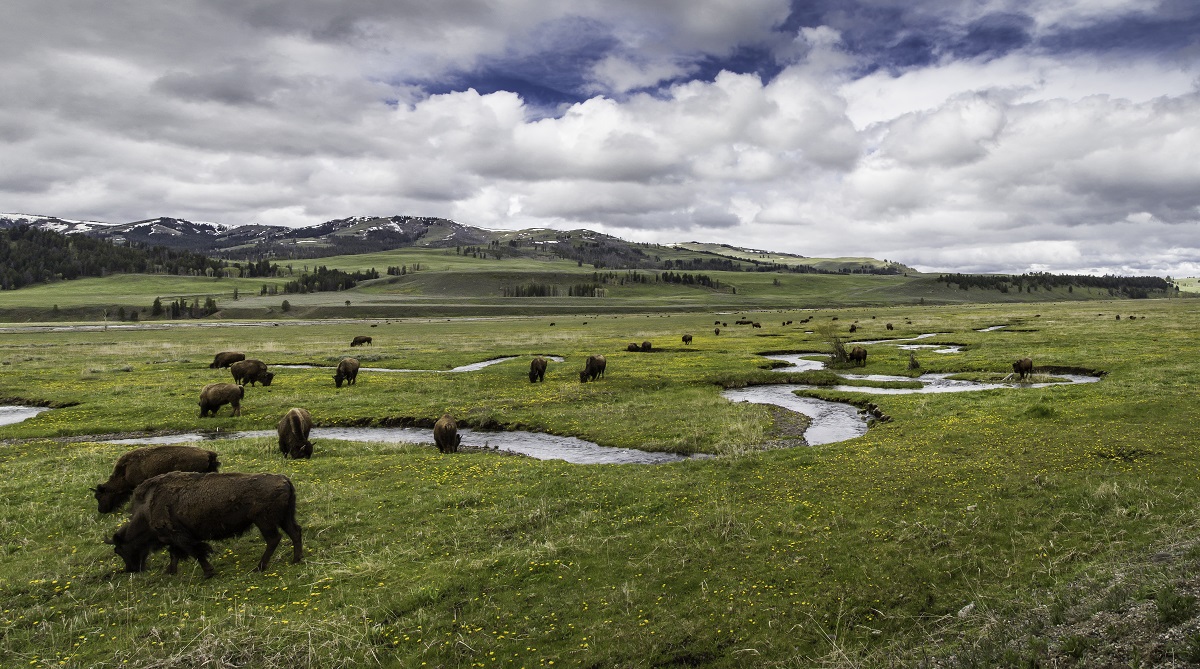


Photo: Bison along Rose Creek in Lamar Valley, Yellowstone National Park, NPS/Neal Herbert

The Remaining Piece of the Plains

Few sportsmen championed the restoration of wild bison as a huntable species more than Posewitz.

In a 2014 video, he called restoring wild bison to portions of the Plains, specifically the Charles M. Russell National Wildlife Refuge, “a moral responsibility. This was the most abused animal on the continent, and we have a chance to correct that.”

It’s a sentiment his son, Andrew Posewitz, echoes.

“I would tell you, and this extends from my dad, the one undone piece from the North American Wildlife Recovery Model is bison,” he said.
Wild bison means restoration of the last huntable species on the plains. It means another opportunity for sportsmen and women, one that has been gone for well over a century.

Andrew Posewitz understands concerns from local ranching communities, but said instead of being afraid of the losses, because we don’t know what they will be, “we should find smart ways to mitigate the risk, so the landowner isn’t paying the full cost.”

States have predation accounts for species like wolves and grizzly bears that help offset losses in certain areas. Bison could be no different.
For many in the conservation community, including on the American Prairie Reserve, the ultimate goal is to have enough bison to hunt. That’s the compensatory management part of restoration.

But exactly what restoration means depends on who you ask. The National Bison Association has a goal of returning 1 million bison to the U.S., either in wild herds or on ranches. Carlson was reluctant to state a specific number as a goal; it will depend on the amount of habitat available.

Whatever the number, Carlson has no doubt buffalo will be restored, eventually.

“All through American history, it’s been the sportsman hunter that has carried the conservation ethic forward and restored wildlife to an entire continent.”
-Jim Posewitz.

The U.S. Fish and Wildlife Service announced plans recently to “engage Tribes and stakeholders on the topics of bison and bighorn sheep reintroductions,” into those areas of Montana where some ranchers and legislators hope to keep them out, according to the Associated Press. Native American lawmakers, including Montana Rep. Tyson Running Wolf, a Blackfeet member from Browning, asked the Biden administration to work on the plan. Running Wolf also urged the administration to look at bison in the Glacier area.

Advocates like the late Jim Posewitz believe that sportsmen and women should lead the charge.

“All through American history, it’s been the sportsman hunter that has carried the conservation ethic forward and restored wildlife to an entire continent,” said Jim Posewitz. “Wildlife conservation began in America when Theodore Roosevelt set us on that course, and it’s going to be up to the sportsmen to get behind it to bring that last animal back to where it belongs on this landscape.”


Christine Peterson has written about outdoor recreation and the environment for the past decade from her home in Wyoming. When she’s not chasing trout or trapping grizzly bears and bighorn sheep, she’s wandering the West’s public lands with her daughter, husband and Labrador. She was the 2020 recipient of BHA’s Ted Trueblood Award.


BHA is actively committed to work that will restore wild bison to public lands and rebuild expansive bison habitat across North America. We, along with other committed partners, including those that are part of the Continental Bison Working Group, will work to affect positive change in management and policy that will grow our wild bison herds for generations to come.  Keep watch for exciting updates and opportunities to take action in the coming months!

About Christine Peterson

Open Spaces reporter for the Casper Star-Tribune.

Print

2025 Public Lands and Waters Photo Contest

Zack Williams

Taking pictures of our backcountry experiences is just one way hunters and anglers capture their most beloved memories in designated wilderness, on Bureau of Land Management tracts, Forest Service parcels, and on public waters in between. And we want to see your pics! Our winners will take home over $8,900 in prizes from partners like Savage, Simms, Fishpond, Seek Outside, Benchmade, Sitka, First Lite, Walton’s, Irish Setter, Grundens, NRS, and more!

Media News North American News Backcountry Journal

The Sharptail Caucus

Ryan Busse
This article originally appeared in the fall 2020 issue of Backcountry Journal.   BY RYAN BUSSE   As a young man I once stood on a mountain ridge so beautiful that I now find it impossible to describe. It was summer and a bird dog was at my side when I discovered the place that would change my life and come to be part of my very being. Like a military bootcamp, it broke me and then built me back up – wild, harsh and unspoiled by the hand of man and owned equally by all citizens of this ...
Media Backcountry Journal media Backcountry Journal

Fall 2020 Issue of Backcountry Journal

Zachary Williams
The Indiana Chapter of Backcountry Hunters and Anglers (BHA), the voice for our public lands in the Hoosier state, is excited to announce a new volunteer partnership with the U.S. Forest Service in the Hoosier National Forest. Located in southern Indiana’s hill country, the Hoosier National Forest consists of 204,000 acres of hardwood forests, streams, and backcountry trails. Known to outdoor enthusiasts as simply “the Hoosier,” this forest is Indiana’s largest public-land holding, ...
Media Backcountry Journal media Backcountry Journal

The Lochsa Story by Bud Moore

Zachary Williams
This title is part of BHA's Jim Posewitz Digital Library: Required Reading for Conservationists    Every book's reading starts with a set of expectations and hopes. I picked up a copy of The Lochsa Story because it took place nearly in my backyard, a place I spend more time than any other; my hope was to learn a little more about my favorite wild country – the one I hope to one day have my ashes scattered in. It seemed almost required that I read it. But what I ended up gaining from the book ...
Media Backcountry Journal media Backcountry Journal

A Fine and Pleasant Misery by Patrick F. McManus

Zachary Williams
This title is part of BHA's Jim Posewitz Digital Library: Required Reading for Conservationists There is a time for reflection, philosophy and politics. And there is a time to lighten up. The cure for solemn self-importance is Pat McManus. No one can wring more laughs out of a hunting, fishing or camping trip than the Idaho-born journalism professor who cranked out essays month after month for Field & Stream and Outdoor Life magazines. His essays are nostalgic and farcical. Their wry jokes, ...
Media Backcountry Journal media Backcountry Journal

Considering the Ethics of Trophy Hunting: Part 2

Brandon Ellis
  This article, produced by Orion, originally appeared in the Summer 2020 issue of Backcountry Journal. Join BHA, support your public lands and waters and get four issues a year of Backcountry Journal in your mailbox, and unlimited digital access to current and back issues.   By Harley McAllister and Corey Ellis   Under what circumstances is the killing of an animal ethical when the primary motivation is not consumption? This is a tricky issue, and all the more so due to the attention it ...
Media Backcountry Journal Backcountry Journal Fair Chase

American Serengeti: The Last Big Animals of the Great Plains by Dan Flores

Zachary Williams
This title is part of BHA's Jim Posewitz Digital Library: Required Reading for Conservationists   Dan Flores is a gifted storyteller and chronicler of the history of the Great Plains and wildlife of the American West. American Serengeti describes a magnitude of life on the great plains that will send your imagination spiraling. He captures its true identity, helping the reader understand the history of the wildlife that calls it home and how we have shaped the landscape and wildlife ...
Media Backcountry Journal media Backcountry Journal

A River Runs Through It by Norman Maclean

Zachary Williams
  This title is part of BHA's Jim Posewitz Digital Library: Required Reading for Conservationists   A River Runs Through It is a memoir of Maclean's adventures as a young man in the mountainous western Montana backcountry. Heralded as a classical American story, Maclean describes fly fishing on the Big Blackfoot River and working in the woods for the U.S. Forest Service. I originally read A River Runs Through It while fly fishing on an alpine backpacking trip in western Wyoming. After a day ...
Media Backcountry Journal media Backcountry Journal

A Hunter’s Heart: Honest Essays on Blood Sport by David Petersen

Zachary Williams
This title is part of BHA's Jim Posewitz Digital Library: Required Reading for Conservationists   Approximately 10 years ago I picked up this book after a reading a magazine interview with the author, David Petersen, in which he nobly described hunters as the type of hunter we all strive to be – thoughtful, hardworking and conservation-minded.  This book includes a carefully selected ensemble of personal essays that dive deep into the motivations and ethics of hunters from different walks of ...
Media Backcountry Journal media Backcountry Journal

American Catch: The Fight for Our Local Seafood by Paul Greenberg

Zachary Williams
This title is part of BHA's Jim Posewitz Digital Library: Required Reading for Conservationists   I’ve read both of Greenberg’s popular books: American Catch and Four Fish. What I like best about American Catch is that it deals not only with the problem of conservation but also the issue of what we eat. The book discusses everything from New York oysters and the destruction of their habitat to the topic of salmon in Alaska and the Pebble Mine and Bristol Bay debacle. American Catch is an ...
Media Backcountry Journal media Backcountry Journal

American Sportsmen and the Origins of Conservation by John F. Reiger

Zachary Williams
This title is part of BHA's Jim Posewitz Digital Library: Required Reading for Conservationists   Reiger’s American Sportsmen is an expanded look into the entwined history of sportsmen, ethics and policy that shaped what we now know as conservation and sustainable management.  Many sportsmen and women, and even historians, are quick to stop at George Bird Grinnell and Theodore Roosevelt – obvious pillars in the Progressive era of the late 1800s and early 1900s – when mapping the lineage of ...
Media Backcountry Journal media Backcountry Journal

Silent Spring by Rachel Carson

Zachary Williams
This title is part of BHA's Jim Posewitz Digital Library: Required Reading for Conservationists   A professor assigned my class Rachel Carson’s “Silent Spring,” the book credited with launching the modern environmental movement, my senior year of college. I hadn’t heard much about the classic then, but I was intrigued enough by Carson’s concern for the future, and the promise of a good grade. I quickly understood why it is a critical read for conservationists and how it popularized the field ...
Media Backcountry Journal media Backcountry Journal

The Only Cutthroat Fly You will Ever Need

Zachary Williams
This article originally appeared in the Summer 2019 issue of Backcountry Journal. Join BHA, support your public lands and waters and get four issues a year of Backcountry Journal in your mailbox, and unlimited digital access to current and back issues.   By Zack Williams There is something uniquely public about cutthroat trout. They reside almost entirely in wild, mountainous rivers of the West – undammed, wild, free places – the vast majority of these flowing through public land from ...
Media Backcountry Journal media Backcountry Journal

Grinnell: America’s Environmental Pioneer and His Restless Drive to Save the West by John Taliaferro

Zachary Williams
This title is part of BHA's Jim Posewitz Digital Library: Required Reading for Conservationists   I’ve read a handful of books in the past couple years that I think should belong in the Backcountry Hunters library, but the one that stands out most and should be required reading for all conservationists and hunters is John Taliaferro’s recent biography, Grinnell: America’s Environmental Pioneer and His Restless Drive to Save the West. I really wasn’t too familiar with George Bird Grinnell ...
Media Backcountry Journal media Backcountry Journal

Desert Solitaire by Edward Abbey

Zachary Williams
  This title is part of BHA's Jim Posewitz Digital Library: Required Reading for Conservationists   When I think of Desert Solitaire I remember a little riverside camp I scraped out of the grass and brush by the Colorado, not far from Moab, Utah, near the mouth of a canyon that’s since been re-named Grandstaff. I was a year out of college and living on public lands: national forests in South Dakota and Wyoming, national monuments in Arizona, BLM lands in Utah, for seasons at a time. Edward ...
Media Backcountry Journal media Backcountry Journal

That Wild Country by Mark Kenyon

Zachary Williams
This title is part of BHA's Jim Posewitz Digital Library: Required Reading for Conservationists  If we’ve learned anything from history, it’s that public lands will always need advocates. Since the beginning, there have been unremitting attempts to privatize our lands for the short-term benefit of a few. In order to be an effective advocate, it’s important to understand how we got where we are today, collective owners of 640 million acres of public lands. Mark Kenyon takes us on a journey ...
Media Backcountry Journal media Backcountry Journal

Tranquility in the Ozarks

Garrett Titus
  By Garrett Titus   The crisp turquoise spring water ripples across the front of my canoe, with the gentle strokes of my paddle and the soothing melody of stirring songbirds the only sounds as I traverse downstream. Steam is coming from the water like a fire that has almost burned itself out, while the sunlight pierces through the sycamores, providing me a clearer path through the rapids and root wads. The river bluffs rise high above on either side almost as if to point my eyes to the ...
Media Backcountry Journal media Missouri Chapter Backcountry Journal

Bloodties: Nature, Culture, and the Hunt by Ted Kerasote

Zachary Williams
  This title is part of BHA's Jim Posewitz Digital Library: Required Reading for Conservationists    In Bloodties, Kerasote brings the reader along with him on three journeys, and each involves hunting but from vastly different viewpoints, motivations and outcomes. His time is spent with natives on the ice edge in Greenland, Westerners in pursuit of rams in Siberia and on a journey home to hunt elk in Wyoming. Each is a story about people and how they interact with one another, the critters ...
Media Backcountry Journal media Backcountry Journal

American Buffalo: In Search of a Lost Icon by Steven Rinella

Zachary Williams
This title is part of BHA's Jim Posewitz Digital Library: Required Reading for Conservationists    Long before he was “The Meateater,” Steven Rinella was just another hunter dreaming of a premium tag and the next adventure. One of his early works, American Buffalo: In Search of a Lost Icon, is the story of receiving one such tag and the ensuing journey. This book is the perfect blend of hunting, adventure, conservation, science and history. Starting with the unearthing of a bison skull by ...
Media Backcountry Journal media Backcountry Journal

The Pennsylvania Chapter’s Huge Win on Sunday Hunting

Don Rank
Photo courtesy of Pennsylvania BHA member John Conte III   By Don Rank   Despite routinely boasting some of the largest numbers of hunters in the United States, Pennsylvania is one of the few remaining states that either restricts or completely bans hunting on Sundays. On Nov. 27, 2019, Pennsylvania Governor Tom Wolf signed Senate Bill 147 into law allowing for three Sundays to be open to hunting. Those three days represent a major victory for hunters in the Keystone State. Sunday hunting ...
Media Chapter News Backcountry Journal Backcountry Journal Pennsylvania Chapter

A Sand County Almanac by Aldo Leopold (NEW Edition!)

Zachary Williams
This title is part of BHA's Jim Posewitz Digital Library: Required Reading for Conservationists   Published posthumously in 1949, Aldo Leopold’s A Sand County Almanac is as close to a bible for conservationists as any work can be. In it he discusses things like a “land ethic,” which simply says: “A thing is right when it tends to preserve the integrity, stability, and beauty of the biotic community. It is wrong when it tends otherwise.” He reflects on predator control in service of better ...
Media Backcountry Journal media Backcountry Journal

2020 Coloring Contest Results

Zachary Williams
Thank you to everyone who participated in our coloring contest from the Winter 20 issue of Backcountry Journal. Everyone did a fantastic job! Choosing only two winners was an extremely difficult proposition but here they are, along with honorable mentions.  A special thank you to Rep Your Water for sponsoring this contest and providing the artwork. Below are a few selected entries:  Winner: Gabriel Langenhan, 8 years old, Washington   Runner-up: Athena Blanco, 9 years old, ...
Media Backcountry Journal Backcountry Journal

Spring 2020 Kid's Crossword Answers

Zachary Williams
Here are the answers to the Kid's Crossword, located on page 17 of the Spring 2020 issue of Backcountry Journal. Not a member yet? Subscribe HERE and get four issues of Backcountry Journal to your door!    *Note: Neve Dyer, age 12, from Alberta, informed us that the answer to 7 down, Canada's national bird, is not the Canada Goose but grey jay. We apologize for this error and will be submitting a grievance with Google! Thank you, Neve, for informing us of this error. -Zack Williams, editor.  
Media Backcountry Journal Backcountry Journal

Ohio BHA Wins Big With State Land Purchase

Jonathan Ingram
Left to right: Tony Ruffing, Ohio BHA chair; Mike DeWine, governor of Ohio; Benton Collins, Ohio BHA wildlife and habitat restoration committee chair; Tim Rogers, Ohio BHA communications co-chair   By Jonathan Ingram The story of Ohio’s American Electric Power ReCreation Lands is a common one east of the Mississippi. It is a story of resource extraction followed by reclamation and resurgence. In the 1960s, AEP concluded a decades long process of strip mining the rich coal deposits that ...
Media Backcountry Journal Ohio Chapter Backcountry Journal

How Texas Public Lands Saved Our Family's Outdoor Legacy

John Cook
We are all partakers in something that is inherently good. The backcountry awakens a pent-up wonder that is innate to our existence. As we breathe in the mountain air or witness the majesty of the river bottom, we are connected to all those who came before us.   By John Cook I grew up hunting the Mud Creek bottom in East Texas. As early as I can remember I was following my dad through the mature hardwood bottom on the north side of our deer lease hunting squirrels. I can remember being ...
Media Backcountry Journal media Texas Chapter Backcountry Journal

The Momentum Builds

Kylie Schumacher
By Kylie Schumacher It’s the shot heard around the world right now in the hunting and angling communities: Hunting and fishing participation is declining. We’re all familiar with the decline in license sales and days spent afield and know all too well the implications of these statistics. With the addition of BHA’s Recruitment, Retention and Reactivation position, BHA is actively working to reverse these numbers, primarily though our Hunting for Sustainability program. While R3 initiatives ...
Media Backcountry Journal Collegiate Clubs Backcountry Journal

Fishing through the Apocalypse with Matt Miller

Zachary Williams
This story originally appeared in the Fall 2019 issue of Backcountry Journal By Hal Herring For author Matt Miller of Boise, Idaho, life is too short to be a fishing purist. His work as a writer on the environment and conservation takes him across the United States, and he fishes wherever he goes, for whatever is there, with whatever method, be it throwing carp heads under a big bobber for monster alligator gar, trying to net cisco on the freezing shores of Bear Lake in Utah, tossing ...
Media Podcasts Backcountry Journal Podcast Backcountry Journal

Texas Chapter Stands for Public Ownership of Wildlife

Richard Rosenthal
By Rich Rosenthal Conservationists celebrated a legal victory over captive deer breeding operations after a Texas appeals court reaffirmed the public ownership of wildlife, thanks in part to efforts from Texas BHA and other like-minded conservation organizations. The opinion made by the Texas Court of Appeals, Third District, affirmed the trial court’s decision in Bailey, Peterson v. Texas Parks & Wildlife Department. In the case, owners of a deer-breeding operation sued the state, arguing ...
Media Backcountry Journal Texas Chapter Backcountry Journal

Yukon Chapter Studies Changes in Public Access

Arkansas BHA Chapter
By Richard Cherepak and Todd Onsorge Yukon Territory is vast, rugged and sparsely populated. Slightly larger than California, Yukon covers an area of 482,443 square kilometers, yet only has 4,850 kilometers of maintained roads (for comparison, Yukon’s western neighbor, Alaska, has more than 25,000 kilometers of public roads). Resident hunters can live the backcountry hunter’s dream – hiking ridges and valleys in isolated and wild terrain in pursuit of caribou, bison, thinhorn sheep, ...
Media Backcountry Journal Backcountry Journal

Backcountry Ice Fishing 101 in the Boundary Waters

Lukas Leaf
This article first appeared in the Winter 2020 issue of Backcountry Journal. Join BHA to get 4 issues a year in your mailbox.  By Lukas Leaf I grew up on the ice, listening to the lake thunder and crack as it constantly expands and shifts. Frankly, you either love it or hate it. Fortunately for me, it’s the former, and I’ve been pursuing everything from walleye to lake trout since I was able to fall through a tip-up hole. It’s a Midwest outdoor tradition filled with eelpout festivals, giant ...
Media Backcountry Journal Public Lands & Waters Backcountry Journal

Central Oregon: The Frontlines of Wilderness Access

Tristan Henry
  By Tristan Henry   In Oregon’s scenic Central Cascades, the undulating terrain that bisects east from misty west has drawn growing crowds of backcountry travelers, summer after summer. Here, admiration and idolization of our peaks and forests have outpaced our ability to manage them according to their land-use designation. As trails are beaten wide and begin to braid, a subsequent slew of consequences ranging from ecological to political erupt into public discourse. Viewed within the ...
Media State Issues Backcountry Journal Backcountry Journal Oregon Chapter

Continuing the Conservation Ethic

Brandon Ellis
  By Corey Ellis One of the greatest impacts of the hunting conservation movement that is our history, all hunters’ history, did not only benefit the game species that hunters pursue. That sage flat that hunters protected not only saved pronghorns and sage grouse; it also saved long-billed curlews and gray flycatchers. A ponderosa glade that was purchased with sportsmen’s dollars and deposited in the bank of public lands not only protected wintering grounds for elk and mule deer; it also ...
Media Backcountry Journal Backcountry Journal Fair Chase

Continued ... An Interview With Hal Herring

Zachary Williams
Photo by Tim Peterson   This is the continuation of our conversation with Hal Herring, host of BHA's Podcast & Blast, from the Winter 2020 issue of Backcountry Journal. For more of this interview with Hal and loads more great content, join BHA to get the current and every new issue of Backcountry Journal in your mailbox.   Those that read your writing, or follow you on social media, know that you are extremely motivated about protecting our public lands, waters and wildlife – the BHA ...
Media Podcasts Backcountry Journal Podcast Backcountry Journal

Connecting People with Wild Places

Arkansas BHA Chapter
  By Mike Clingan, Montana Outdoor Imagery   An email in my inbox from BHA caught my attention: “6 days volunteering for the Bob Marshall Wilderness Foundation to improve trails in the backcountry with fellow BHA members.” Exactly the type of adventure that I needed and an opportunity to contribute to a place and cause that mean so much to me.   BHA partnered with the Bob Marshall Wilderness Foundation, which was founded in 1996 when the U.S. Forest Service and a group of concerned citizens ...
Media Backcountry Journal Montana Chapter Backcountry Journal

R3: Revelations, Relationships and Reciprocity

Gabriela Zaldumbide
BHA Hunting for Sustainability students discuss public and private land boundaries. Photo by Alex Kim   This article originally appeared in the Fall 2019 issue of Backcountry Journal. By Gabby Zaldumbide The Wisconsin air was bitter cold. Turkey season had unfolded, but winter refused to end. As I sat perched on the ground, shotgun in one hand and hot coffee in the other, my hunting instructor and I could hear gobbles as the turkeys left their roost before sunrise. We set up in tall grass ...
Media Backcountry Journal Mentorship Backcountry Journal

Arizona Chapter Defeats Public Land Transfer Attempts

Justin Nelson
This article originally appeared in the Fall 2019 issue of Backcountry Journal.   By Justin Nelson Earlier this year, Arizona BHA heavily engaged in a fight against two bills that had the potential to significantly change the way public lands are perceived and managed in the state of Arizona. HB 2547 and HB 2557 were the latest efforts in a drawn out and consistent focus to undermine the status of public lands in Arizona. Both of these bills were a continuation of similar legislative public ...
Media Chapter News Backcountry Journal Backcountry Journal Arizona Chapter

Saving Coni Island

Barry Whitehill
South of the Brooks Range in northern Alaska there still exists intact ecosystems that remain largely unchanged except by forces of nature.  This is one of the largest public land wild areas left in the U.S.  Hunting and fishing here is the dream of many sportsmen and women, but to the people in remote communities of this region it is their subsistence use area as it always has been.  The subsistence use and sport hunting and fishing opportunities are on the brink of being drastically ...
Media Chapter News State Issues Backcountry Journal Backcountry Journal Alaska Chapter

Inside the Fall 2019 Issue of BHA's Backcountry Journal

Zachary Williams
Full digital issues of the Backcountry Journal are available to BHA members. Check out a preview below, or click here to join BHA. Already a member? Click here to log in. News for Immediate ReleaseSept. 26, 2019Contact: Katie McKalip, 406-240-9262, mckalip@backcountryhunters.org  The newest issue of Backcountry Hunters & Anglers’ magazine is available today MISSOULA, Mont. – The fall issue of Backcountry Hunters & Anglers’ quarterly magazine, Backcountry ...
Media Press Releases Backcountry Journal media Press Releases Backcountry Journal

Physical Fitness as part of Ethical Hunting

Brandon Ellis
Photo by Alex Kim   This article first appeared in the Fall 2019 issue of Backcountry Journal. Join BHA and get the journal, quarterly, in your mailbox. By Corey Ellis While recently rereading Beyond Fair Chase by Jim Posewitz, the founder of Orion and a conservation legend and expert in hunting ethics, I was struck by a section that had not caught my attention before; the section was titled, "Physical Fitness as a Part of Preparation." Although we often think of fitness in preparation ...
Media Backcountry Journal media Backcountry Journal Fair Chase

Soldier's Solace: A Mental Congressional Testimony

Arkansas BHA Chapter
This article originally appeared in the Spring 2018 issue of Backcountry Journal.   BY Lieutenant Colonel JEFFREY M. JONES, U.S. ARMY RESERVE   I spent the morning reading “The Battle for Alabama’s Wilderness: Saving the Great Gymnasiums of Nature” by John Randolph, sent to me by a fellow member of the BHA Southeast Chapter Board, in a containerized housing unit in Baghdad, Iraq. I was amazed at the fortitude and tenacity of the public land champions in that era – regular folks who were able ...
Media Backcountry Journal Armed Forces Initiative Backcountry Journal

Inside the Summer Issue of BHA's Backcountry Journal

Arkansas BHA Chapter
Full digital issues of the Backcountry Journal are available to BHA members. Check out a preview below, or click here to join BHA. Already a member? Click here to log in. News for Immediate ReleaseJuly 22, 2019Contact: Katie McKalip, 406-240-9262, mckalip@backcountryhunters.org The newest issue of Backcountry Hunters & Anglers’ magazine is available today MISSOULA, Mont. – The summer issue of Backcountry Hunters & Anglers’ quarterly magazine, Backcountry ...
Media Press Releases Backcountry Journal Press Releases Backcountry Journal

Is CWD an ethical issue?

Arkansas BHA Chapter
This article first appeared in the Summer 2019 issue of Backcountry Journal. Join BHA and get the journal, quarterly, in your mailbox.   By Patt Dorsey   There is a lot we know about chronic wasting disease and there is much to learn. We know that CWD is affecting members of the deer family, including mule deer, white-tailed deer, elk and moose. We also know that CWD is spreading. Biologists have now detected it in 26 U.S. states and in three Canadian provinces. Scientists know that prions ...
Media Backcountry Journal Backcountry Journal Fair Chase

Students: Set your sights on Minnesota

Arkansas BHA Chapter
The Spring 2019 issue of Backcountry Journal featured an article, “Student Licenses Aid in Recruitment,” that detailed how discounted student license rates help R3 efforts across the country and called for more states to offer college students licenses at resident rates. The graphic included with the article mistakenly did not show Minnesota as offering these discounted student rates, which it does. The below article, contributed by the Minnesota DNR, details their R3 and student recruitment ...
Media Backcountry Journal Collegiate Clubs Backcountry Journal Minnesota Chapter

Student Licenses Aid in Recruitment

Sawyer Connelly
This article first appeared in the Spring 2019 issue of Backcountry Journal. Join BHA to receive the quarterly Backcountry Journal, in print, direct to your mailbox.     Editor's Note: The original version of this article contained a graphic that incorrectly showed Minnesota as not offering student licenses at resident rates. This graphic has now been corrected. You can read more about Minnesota's R3 efforts and student licensing in this guest blog post, "Students: Set Your Sights on ...
Media Backcountry Journal Collegiate Clubs Backcountry Journal

Navigating Rendezvous 2019

Zachary Williams
Above: The 2018 Hike to Hunt kickoff. by Josh Mills So you’re going to Rendezvous, huh? Get excited. You’re about to be part of the biggest public lands party you’ve ever seen. Your mind is about to be blown, you’ll meet countless likeminded people – who come from a vast array of backgrounds – united in the spirit of fair chase and public lands and waters activism. Saddle up, partners; it’s a wild ride.Advice from navigating the past three Rendezvous: Introduce yourself to anyone and ...
Media Backcountry Journal Backcountry Journal

Are Big Racks Ethical?

Zachary Williams
Above: In 2016 the BHA North American board passed a policy statement in support of policies which aim to prohibit new captive cervid canned hunting operations. As concerns around the spread of CWD from captive cervid operations mount throughout the country, BHA chapters are drawing on this statement to advance policies that put meaningful limits on such operations. Photo by Lynn Bystrom   by Jan Dizard   Orion and BHA share a commitment to face clearly the many ethical and related ...
Media Backcountry Journal Backcountry Journal Fair Chase

Inside the Spring Issue of BHA’s Backcountry Journal

SuperUser Account
News for Immediate ReleaseApril 16, 2019Contact: Katie McKalip, 406-240-9262, mckalip@backcountryhunters.org   The newest issue of Backcountry Hunters & Anglers’ magazine is available today   MISSOULA, Mont. – The spring issue of Backcountry Hunters & Anglers’ quarterly magazine, Backcountry Journal, hit mailboxes across the continent last week. This issue contains 70-plus pages of stories, news and photographs of hunting and fishing North America’s public lands and waters. Here’s a ...
Media Press Releases Backcountry Journal Press Releases Backcountry Journal

Backcountry Journal Winter 19' Teaser

SuperUser Account
News for Immediate Release Jan. 28, 2019 Contact: Katie McKalip, 406-240-9262, mckalip@backcountryhunters.org   Inside the Winter Issue of BHA’s Backcountry Journal The newest issue of Backcountry Hunters & Anglers’ magazine is available today   MISSOULA, Mont. – The newest edition of BHA’s quarterly publication, Backcountry Journal, has arrived in members’ and distributors’ mailboxes. This issue, featuring cover art by Ed Anderson, runs the gamut of public lands hunting and fishing in North ...
Media Press Releases Backcountry Journal Press Releases Backcountry Journal

The Boundary Waters Canoe Area Wilderness

Sam Lungren
By Sam Lungren, Backcountry Journal editor This piece was published in the Fall 2018 issue of Backcountry Journal. Since this article was published, the Biden administration has begun their reconsideration of the previous administration’s decision to extend leases for copper mining in the Superior National Forest upstream of the Boundary Waters Canoe Area Wilderness. In August 2021, President Biden's Secretary of Agriculture told the public that he was waiting for a legal opinion from ...
Media Backcountry Journal media Public Lands & Waters Backcountry Journal

Grip and Grin: Ethics and Emotions in Images

Sam Lungren
by Tovar Cerulli - Orion: The Hunter's Institute The image is familiar: A hunter crouches beside a dead deer, grinning into the camera. What do we make of this picture? We all see the hunter’s smile. We all see the beautiful animal, now dead. And we all recognize some connection between the two. From there, though, interpretations diverge wildly. Critics of hunting are apt to see mindless brutality. The hunter has killed, appears to have enjoyed killing, and now gloats over a carcass. ...
Media Backcountry Journal media Backcountry Journal Fair Chase

Live Action Game Cameras

Jan Dizard
Photo by Barry and Cathy Beck On an October morning a decade or so ago, I was hunting woodcock in an abandoned orchard. A flight had come in and, in less than an hour, I collected my three-bird limit. That evening I got a call from an acquaintance, a deer hunter, who hunts the same orchard. He asked how I did and if I’d seen evidence of deer. How, I asked, had he known I had been hunting there that morning? He said he saw me on the trail camera he’d placed in cover. I was amused. It’s now ...
Media Backcountry Journal media Backcountry Journal Fair Chase

From Backcountry Journal: Crazy Business

Don Thomas
Image courtesy of Don Thomas   Readers and BHA members outside of Montana may have never heard of the Crazy Mountains, although that is likely to change. One of Montana’s dozen isolated “island” ranges, the Crazies lie an hour’s drive northeast of Bozeman. They offer spectacular wilderness terrain and are home to native cutthroat trout, an over-objective elk herd, deer, mountain goats and large predators galore. Their current notoriety derives not from this natural bounty, but from a heated ...
Media State Issues Backcountry Journal Montana Chapter media Backcountry Journal

Fair Chase and Public Access: Joined at the Hip

Jan Dizard
Photo by Daniel Wilde For roughly two-thirds of the 20th Century, hunters and fishers were the bedrock of conservation. But beginning in the early 1970s, the ground shifted. The accomplishments of the conservation movement, to which hunters contributed mightily, began to pale in the face of new environmental issues and a new environmental movement that had priorities not centered on restoration of game and fish and the habitats on which they depend. Indeed, protection of wildlife and ...
Media Backcountry Journal media Backcountry Journal Fair Chase

Yoga for Hunters

Erika Putnam
Published in Backcountry Journal Winter 2018 Issue. Subscribe by becoming a member here.                  Photo Credit: Bill McDavid It took me 16 days to tag a Dall sheep in Alaska last year. If it weren’t for my yoga practice, I don’t think I could have stayed mentally strong or returned home injury free. I’m 49 years old, so my yoga doesn’t look like sitting cross-legged under a tree and my goal is not to do a photo-worthy backbend. I practice a combination of meditation, yoga poses, ...
Media Backcountry Journal media Backcountry Journal

A Conversation with Jim Posewitz

Sam Lungren
Published in Backcountry Journal Winter 2018 Issue. Subscribe by becoming a member here.  Photo Credit: Thom Bridge Interview by Sam Lungren Author, biologist, ethicist, historian and legendary conservationist, Jim Posewitz is the foremost expert on conservation history and fair chase hunting. He founded Orion – The Hunter’s Institute and has penned five books: Beyond Fair Chase, Inherit the Hunt, Rifle in Hand, Taking a Bullet for Conservation and his soon-to-be-released memoir, My Best ...
Media Backcountry Journal media Backcountry Journal

Inside the Winter Issue of BHA’s Backcountry Journal

SuperUser Account
MISSOULA, Mont. – The winter 2018 issue of Backcountry Journal is arriving in BHA members’ mailboxes in time for the holidays. Here are some highlights from this issue: Required Reading: We asked our staff, board and some literary friends about their favorite books and why they matter. The result is a “best of” list of works critical to the sportsmen-conservation movement and understanding the people and ideas behind it. It also offers some top-notch fireside reading this winter…and gift ...
Media Press Releases Backcountry Journal Press Releases Backcountry Journal

Inside The 2017 Fall Journal

Trey Curtiss
News for Immediate ReleaseOct. 27, 2017Contact: Katie McKalip, 406-240-9262, mckalip@backcountryhunters.org Inside the Fall Issue of BHA’s Backcountry Journal The newest issue of Backcountry Hunters & Anglers’ magazine is available today MISSOULA, Mont. – The fall 2017 issue of Backcountry Journal is landing in BHA members’ mailboxes now. Here’s a look at some of the highlights: Speechless: Dreams, Nightmares & Wyoming Moose: BHA life member Jared Oakleaf shares how a typo almost cost him ...
Media Press Releases Backcountry Journal media Press Releases Backcountry Journal

Inside the Spring Issue of BHA’s Backcountry Journal

SuperUser Account
MISSOULA, Mont. – The spring 2017 issue of Backcountry Journal is arriving in BHA members’ mailboxes this week. Here’s a taste of what you'll find inside: Missouri River on the Fly: Renowned author E. Donnall Thomas Jr. and his wife Lori retraced the steps of the Lewis and Clark Expedition through Montana’s Missouri River Breaks, one of the areas least changed since the Corps of Discovery’s visit. They sought walleye on the fly but instead found goldeye and channel catfish – a fine ...
Media Press Releases Backcountry Journal Press Releases Backcountry Journal

Inside the Winter Issue of BHA’s Backcountry Journal

Anonym
The newest issue of Backcountry Hunters & Anglers magazine is available today MISSOULA, Mont. – The winter issue of Backcountry Journal is arriving in BHA members’ mailboxes now. Here’s a taste of what you'll find inside: Is Wildlife Viewing the New Hunting?: In 1960, the U.S. Fish and Wildlife Service counted almost 14 million hunting license holders in the U.S. Despite there being 140 million more Americans today, hunter numbers haven’t changed. But wildlife watching is on the rise. Ed ...
Media Press Releases Backcountry Journal media Press Releases Backcountry Journal

12,000 Years of Great Fishing

Holly Endersby
The following was written by BHA's Conservation Director Holly Endersby, after a recent fishing trip to Kelly Creek (Idaho). Utter the words Kelly Creek to a real backcountry trout bum and she will immediately know you’re talking about an icy cold stream sparkling through a big chunk of central Idaho beginning near the Montana border. A blue ribbon, catch and release trout stream, Kelly Creek eventually mingles its water with the North Fork of the Clearwater River. A recent University of ...
Media Backcountry Journal media Backcountry Journal

About Backcountry Journal

Backcountry Journal is the quarterly membership magazine of Backcountry Hunters & Anglers. Each issue covers conservations issues, BHA news and exciting hunting and fishing stories from your wild public lands, waters and wildlife across North America.

Submission Guidelines


Not Yet a Member?

Support your wild public lands, waters, and wildlife by becoming a BHA member today and get four issues a year of Backcountry Journal in your mailbox, including unlimited digital access to current and back issues!

Join BHA