By: Alec-Boyd-Devine
The Tongass holds a special place in my heart. Before moving to Alaska, I had lived in Wyoming and hunted public lands in Wyoming, South Dakota, Michigan, and a few other states. However, something about the Alaskan backcountry felt different, and after a few years of hunting and fishing it, I realized it is different. For this reason, when my good friend and hunting partner Derek invited me to do a backcountry spring bear hunt, I said absolutely.
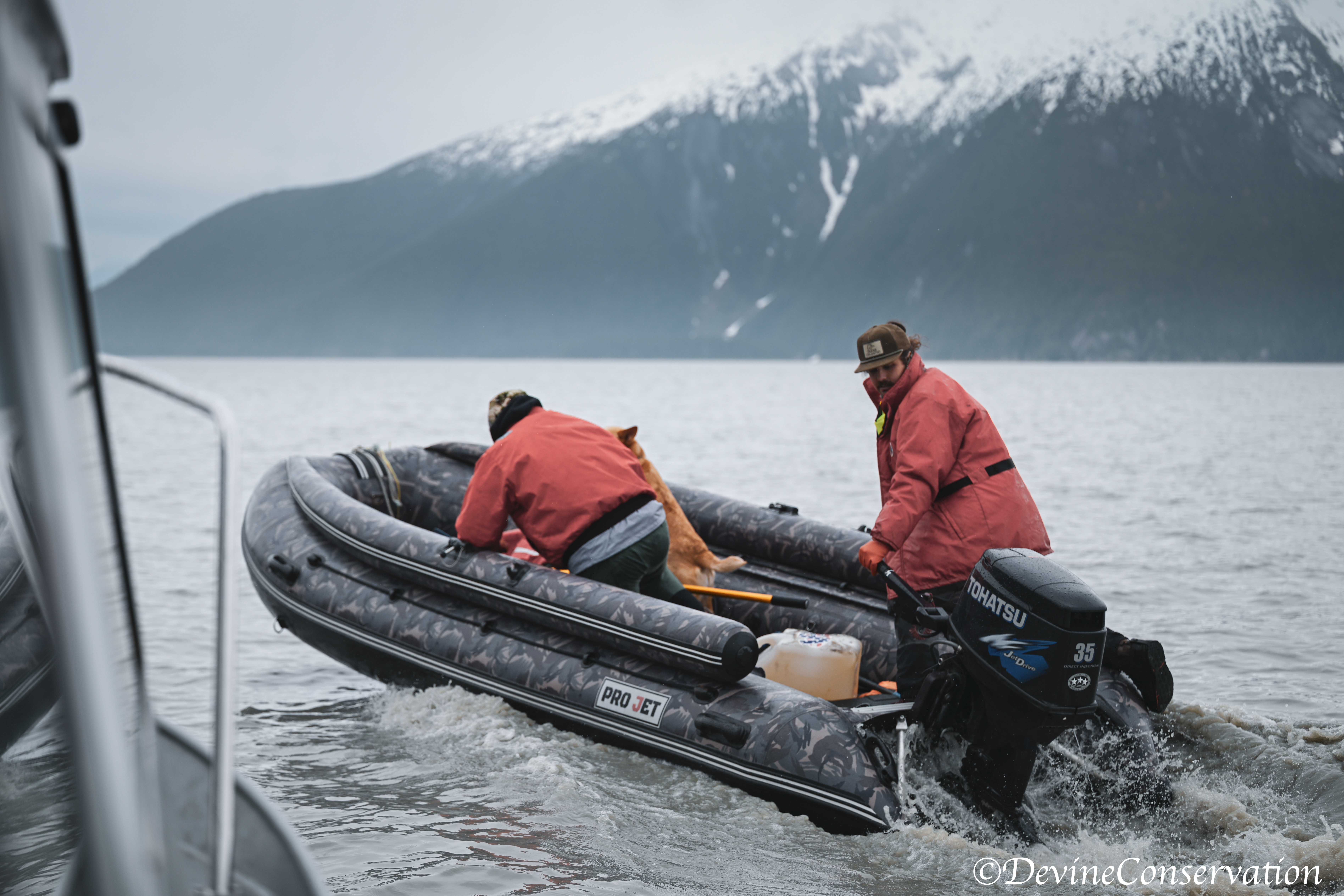
This hunt would be unique for a few reasons. The first was its location. The plan was to take my boat through the Inside Passage and make a spike camp near one of the large glaciers in Southeast Alaska. Hunting in the face of a glacier has got to be one of the most unique experiences there is. Many glaciers wind their way through Southeast Alaska; however, hunting so close to one was a new experience for me. Glaciers are like rivers of ice; they move. Most glaciers in Southeast Alaska are retreating, and in the space they inhabited not so long ago, beautiful, rich ecosystems have emerged.This ecosystem is different from much of the beautiful old-growth forest that defines the Tongass. The ecosystem near the glacier is… new.
The glaciers in this area have been around for thousands of years, covering the earth and carving the fjords that weave their way through Southeast Alaska. These rivers of ice, of course, block anything from growing underneath them. However, as they retreat, leaving barren rock, the forest begins to repossess this nearly de-iced landscape. This new-growth forest is perfect habitat for bears emerging from their dens each spring. Bears in Southeast Alaska are partial to salmon. However, most bears are awake before the salmon begin to run. In spring, bears eat a variety of things, from mussels and clams to roots and grasses. If you can find a spot where the bears are cut off from mussels and clams and forced to only eat vegetation, the likelihood is high of harvesting a tasty black bear.
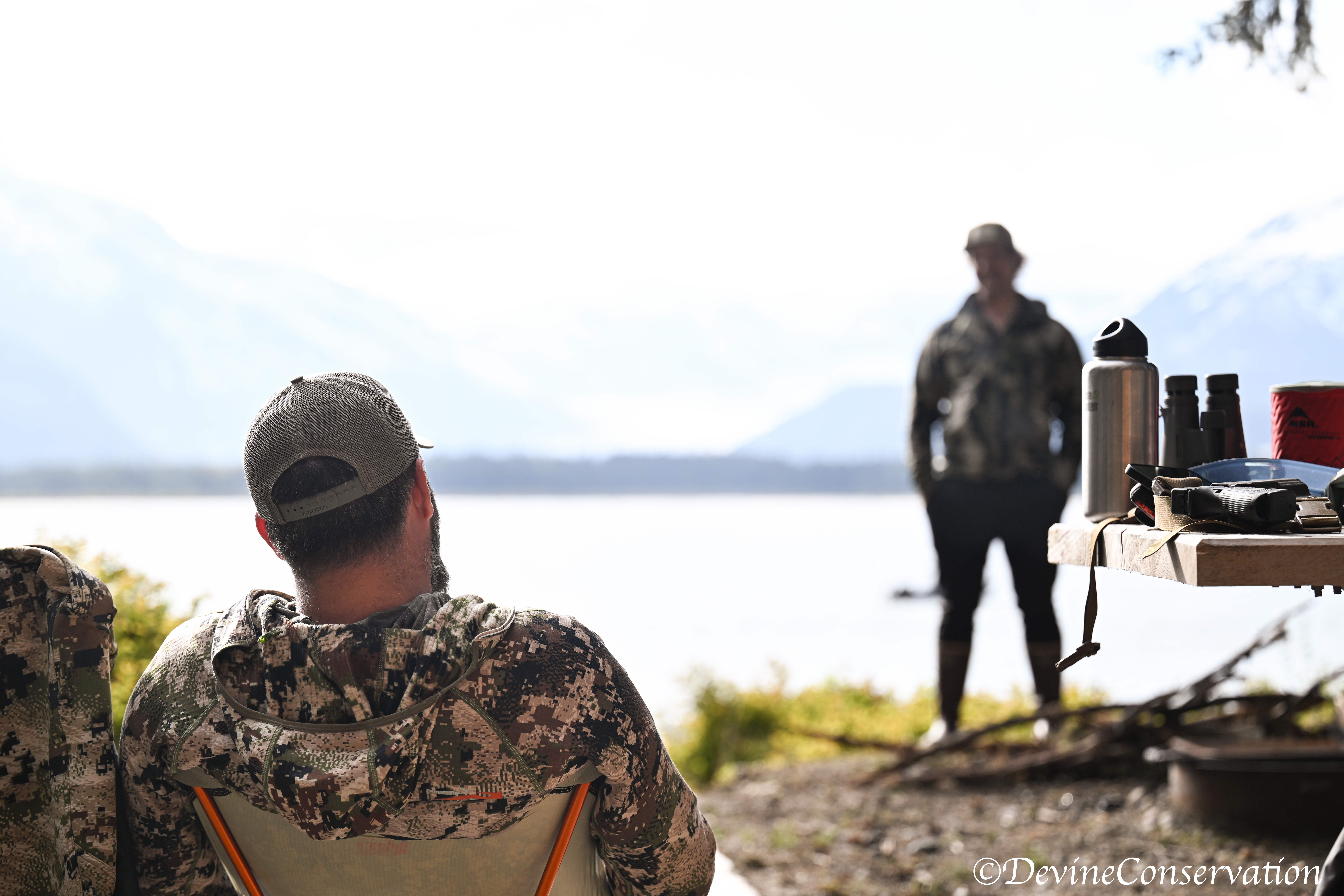
I was particularly excited about our chosen location, as it was somewhere I had never explored before. This brings me to the second unique part of this trip: the attendees. Derek is a lifelong hunter, and his best friend, Victor, has also been a lifelong hunter, with both residing in Alaska for many years. Victor and Derek had cut many notches in multiple tags for different species in Southeast Alaska and in the Lower 48. I, however, had not. I have significant experience hunting waterfowl across the country and a few successful big-game hunts in the Lower 48. Ultimately, though, I grew up as a whitetail guy. I hunted public lands in Indiana, Kentucky, Ohio, and Michigan, mostly. Now, my inexperience in Alaska big game hunting was one thing. The last two members of our party were in a completely different ballpark. Brothers John and Seth were lifelong friends of Derek. Seth and John had never visited Alaska, but more importantly, neither had ever hunted. I'll be honest: when Derek told me that the last two members of our party had never been on a hunt before in their lives, I was a little nervous that a backcountry bear hunt in the Tongass might be a bit over-the-top. Derek assured me that they would be alright, and no matter the outcome, it would be an incredible trip.
The day came for us to begin making our way toward our chosen area to hunt. I woke up early to check the various weather stations so I could get a good idea of the sea's state. Unfortunately, it didn't look good. A storm had blown through, and the ocean was rolling five-footers in a washing-machine-like fashion. Five-footers in my boat are uncomfortable but completely doable. However, the last piece of the puzzle was our plan of towing a jet boat the whole way in order to access even more remote areas up various rivers. We decided to postpone our trip by a few hours so the sea could calm down.
I arrived at Derek's house to meet John and Seth. As we loaded things into the boats, I began getting to know John and Seth, and I imagine they, too, were feeling out their new adventure buddy. We splashed both boats into the cold spring water and began making our way toward our expected spike camp spot. After a very slow boat ride, we finally arrived at one of the most beautiful places I have ever been. As someone who is blessed to call this place home, it continues to astound me how dramatic the landscapes can be here. That night, we split into a couple of groups. I had previously done some E-scouting and found some areas I was intrigued to look into. I asked to be dropped off on a large section of beach and was told that I would be picked up after dark. This meant a pickup time around 11 PM. As I began walking around the area I had scouted, I quickly realized I had made a mistake. On one side of me was the river, which was moving much too quickly to cross. As I ventured out into the swath of grasses, I realized a second river was running parallel to the one I had just been dropped off on the bank of. Contrary to Google Images, I proceeded to spend the next three hours on an island in the middle of the river, pondering my thoughts and attempting, unsuccessfully, to glass the surrounding landscape for bears I could follow up on the next day.
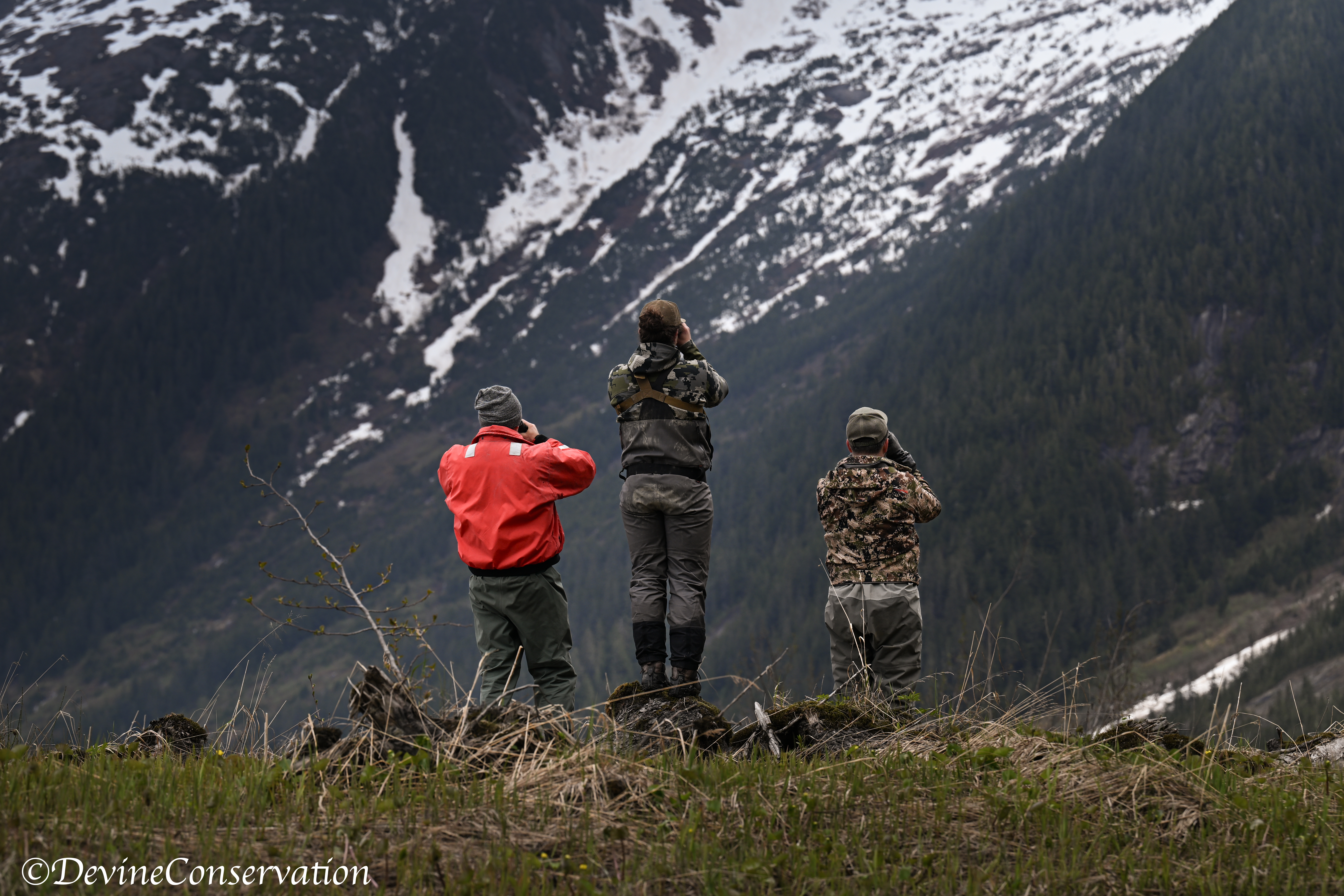
A few hours later, I heard the familiar hum of a jet boat, which I hoped would be carrying my friends with a bear. However, no bear was in the boat. The guys were eager to share their scouting endeavors, along with stories of seeing two newborn moose with their mothers. That night, as we were heading to bed, I felt fairly defeated and decided I needed to make the most of the next day, since my faulty E-scouting had wasted my first night in this landscape.
I woke up just a few hours later, as it began getting light at about 3:30 a.m. at that time. I set out hiking from our camp into an area that appeared to have potential. I made my way down the beach and rounded a corner. As I came around the corner, I looked over to my left and caught the dark shape of a bear feeding in the brush about 200 yards away. As a resident, I could shoot either a brown or a black bear. However, I was really only hoping to shoot a black bear for a number of reasons, including meat quality and freezer space. I began glassing the bear. Initially, I thought I had found a black bear. The size was correct for a black bear, and the behavior was as well. However, the animal was digging and appeared to have a small hump over its shoulder. Additionally, it was light brown in color. I decided I wanted to get a closer look. I crept closer and closer to the bear, my heart rate steadily increasing with each step I advanced. As I got about 100 yards away, I raised my rifle to reassess the bear. Just then, his nose took to the sky, and he scampered off into thick brush. As he ran, I realized it was absolutely a light-colored black bear. I braced my rifle against a stump, hoping he would come out again but knowing that he likely would not. After what seemed like an hour but was likely only minutes, I relaxed my rifle, only to catch a glimpse of the bear moving up the ridge about 150 yards away. I quickly put the crosshairs on the bear's vitals and squeezed off a round. As I peeked around the scope, the bear casually walked off into the woods. After searching relentlessly for blood, I decided to assess my rifle. To my dismay, the front ring on my scope was completely loose. My guess was that the four-foot waves had likely bounced the rifle around enough. Disappointed, I hiked back to camp to reassess.
Upon my arrival, the group asked what had happened, and I explained the story to them. Fortunately, we had a few rifles, and since Victor had previously harvested a bear, he offered his to me. That night, Derek, John, and Seth ran up the river in the jet boat. I decided that I wanted to venture down to the same area that I had gone to that morning. “Go to where the ducks are, not where you think they should be,” is a common phrase that I have learned to live by in the waterfowl world. I figure it is probably applicable in the bear world as well. Victor and I began our hike, planning to go about two miles from camp. As we arrived at the area I had scouted previously, I spotted a bear about three-quarters of a mile farther away.
We quickly began moving toward the bear, and after about 15 minutes of navigating, we arrived near where we had seen the animal. The bear had likely navigated back into the woods. We found a good spot to glass the surrounding area. Victor then spotted a bear about a mile from where we had just come. It was getting dark, so we had to move quickly, covering the ground we had just maneuvered over. Once we got back to the spot where we had originally set up, we began to glass again for the animal we had seen. After a few minutes, we saw the bear digging in some taller grasses that had mostly covered it up. I knew that I had a minimal amount of time since the shadows were getting longer and longer, and darkness crept in.
I began cutting the distance to the bear, only for it to meander back into the woods.
Defeated, I turned to Victor, and over my shoulder he spotted yet another bear. It was a far shot—over 400 yards—but I had been practicing weekly before this hunt, knowing that I may have to make a long shot. The bear had a good backstop behind it, and his vitals were completely exposed. Doubt began to creep into my head after the morning’s failure. I took a few deep breaths to calm myself and squeezed off a round. Hit. The bear rolled, and I squeezed off another round. In brown bear country, tracking a wounded black bear was not on my to-do list.
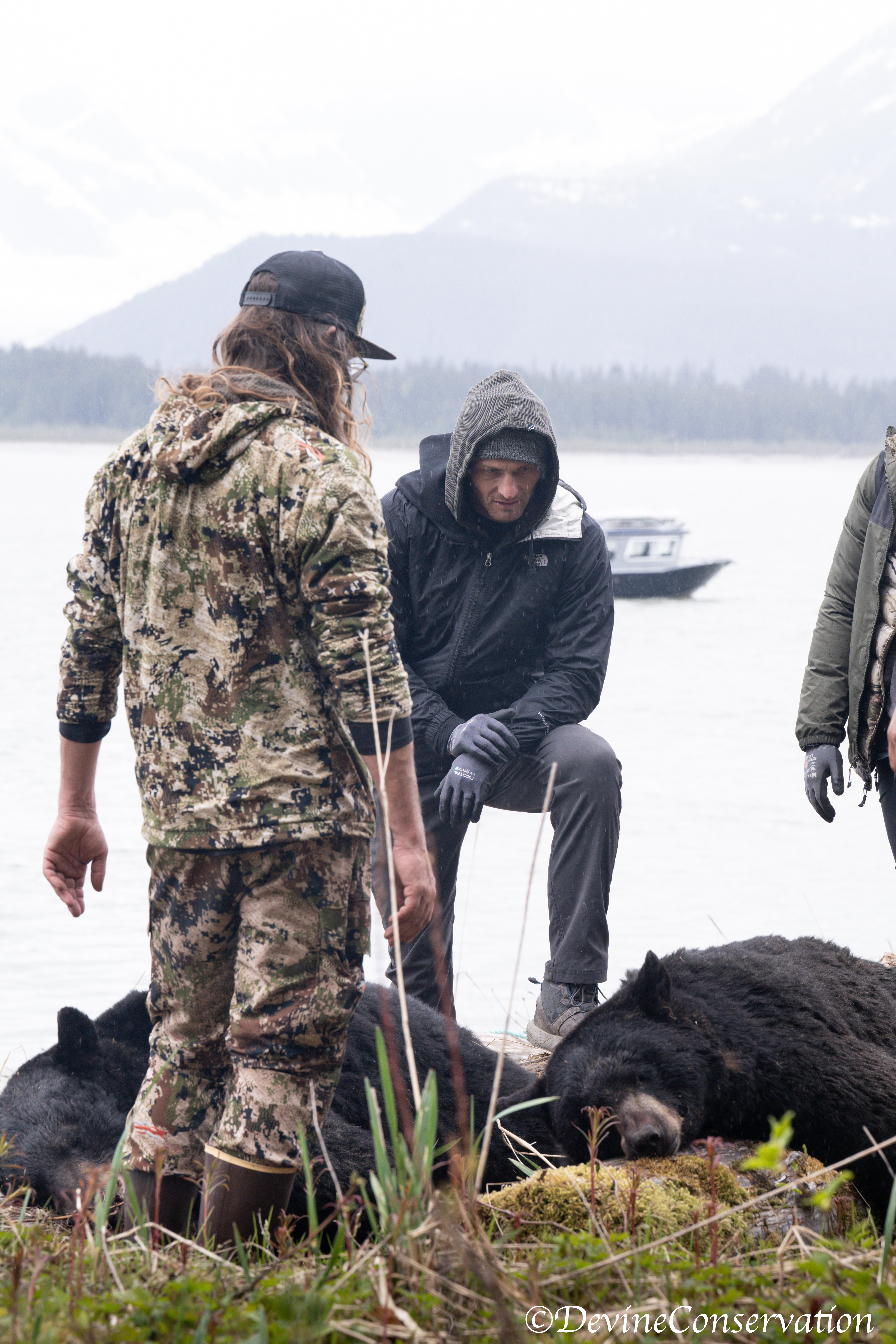
As I gave thanks for the animal's life, I again began to realize how special a place like the Tongass is. This has got to be one of the few places in the world where you can bear hunt on beaches in front of a massive glacier. The Tongass is certainly one of the only places to give a bear hunter multiple opportunities at failure before finally finding success. Finally, the Tongass is a teacher, and like the best teachers, it fosters growth, passion, and patience. Perhaps most important, the Tongass, with its towering mountains, rivers of ice, and old-growth forest, fosters passions for the public lands that are uniquely American.
The Tongass is valuable for the above reasons, but also, it is valuable for so much more than its resources. These lands and waters are intrinsically tied to each other. The glaciers provide silt, which acts as a fertilizer for the marine ecosystems. In turn, the marine ecosystems provide nourishment for salmon. These salmon then run into the various streams and rivers and provide food for the various animals who eat them, and in turn, fertilize the forest. These connections are unique and important to protect. If roads are carved into this landscape, they threaten these important balances.
In an ever-connected world, remote locations need protection, so people can disconnect. As hunters and anglers, this disconnection from the day-to-day reconnects us with the values we share. As a hunter and angler who calls the Tongass home, I find its remoteness is one of the many things that make it unique. When this remoteness is threatened, what the Tongass is is threatened. When a road is built, something is lost and cannot be undone. This remoteness is something which every hunter and angler should experience, and the Tongass is an incredible place to do so.
455